
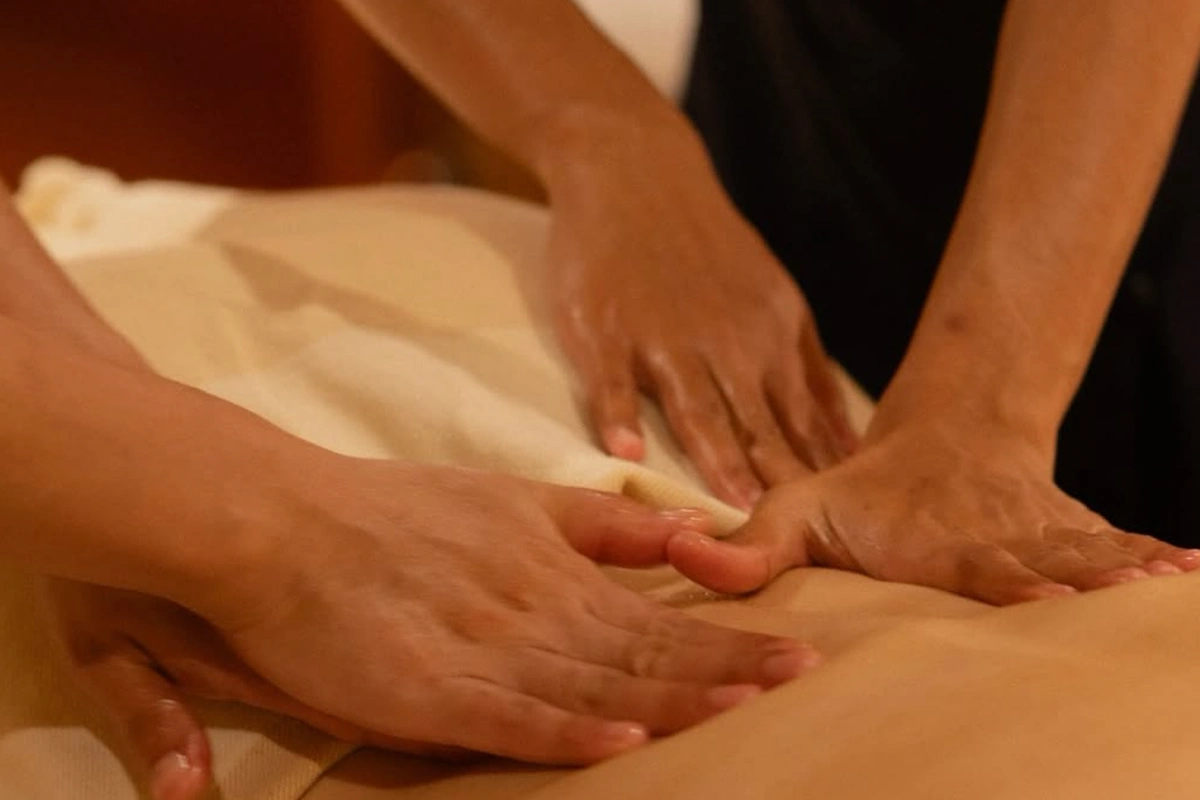
A Four Hands Massage is a premium spa technique in which two certified therapists work on a single guest at the same time and in full coordination. It is also known as a “four-handed massage” or, in international terminology, a tandem massage.
What sets the technique apart from a standard massage is not only the number of therapists. The two therapists do not work independently, but within a predetermined rhythm and sequence of movements. This synchronisation makes the experience qualitatively different.
The Neuroscience: Why Is It So Effective?
In a standard massage session, the nervous system processes a single stream of stimulation. The brain passively tracks the position of the therapist’s hands, the pressure applied and the next movement. Although this monitoring is entirely unconscious, the analytical mind remains active.
Simultaneous, differing stimulation from two separate areas of the body can interrupt this tracking. Because the brain cannot process two parallel streams at once, the analytical mode switches off and the parasympathetic nervous system — the rest and recovery mode — engages much more quickly.
As a result, a Four Hands Massage brings you, in far less time, to the state of deep relaxation that standard sessions reach only after 30–40 minutes.
How Does a Session Work?
Before the session, both therapists hold the consultation with the guest together rather than separately. Preferred pressure, focus areas and any health restrictions are determined at this stage.
Throughout the treatment, the therapists work in silent coordination: while one focuses on the upper body, the other works on the lower body, and transitions happen simultaneously. This unity of rhythm is deliberate and is a skill that requires training.
A session usually lasts 60 or 90 minutes. At the end, both therapists withdraw at the same moment, and the guest is given ample time to rise from the table.
How It Differs from a Standard Massage
| Feature | Standard Massage | Four Hands Massage |
|---|---|---|
| Number of therapists | 1 | 2 |
| Time to deep relaxation | 30–40 minutes | 10–15 minutes |
| Body coverage | Sequential | Simultaneous |
| Effect on the nervous system | Gradual | Rapid parasympathetic shift |
| Coordination required | None | High, between therapists |
Who Is It For?
A Four Hands Massage is especially valuable for:
- People working under heavy mental load, whose analytical mind finds it hard to “switch off”
- Those who don’t find enough relaxation in standard massages
- Time-pressed guests seeking maximum effect in a short time
- Those who want broad body coverage combined with Deep Tissue techniques
Contraindications
A Four Hands Massage carries the same contraindications as a standard massage: active infection, deep vein thrombosis, the first trimester of pregnancy, advanced osteoporosis and the use of blood thinners are all considered in this context. If you have any chronic condition, simply let your therapists know before the session.
Four Hands Massage vs. Couples Massage
These two concepts are often confused:
- Four Hands Massage: One guest, two therapists — a synchronised treatment.
- Couples massage: Two guests, one therapist each in the same room — two separate, independent sessions.
If focus and a personal experience are the priority, choose a Four Hands Massage; if you are planning a session together, choose a couples massage.
Four Hands Massage at O’Spa
At O’Spa, Four Hands Massage is offered only by pairs of certified therapists experienced in working together. A consultation before each session tailors the pressure, focus area and technique combination (Swedish, Deep Tissue or Aromatherapy based) to you personally.
Frequently Asked Questions
Is a Four Hands Massage suitable for a first massage?
For those with no massage experience, a standard session is recommended first. A Four Hands Massage is hard to appreciate without a point of reference, and truly feeling the difference requires a basic basis for comparison.
Do both therapists use the same technique?
The technique combination is determined by the guest’s preference. Both therapists may apply the same technique in sync, or different techniques may be used on different areas.
Can I talk during the session?
Yes. If you would like to change the pressure or the focus area, you can guide the therapists during the session. They respond to this feedback immediately.


